KASA Announces Initial Operational Results of Arirang-7 and CAS500-3; High-Resolution Images of Jamsil Olympic Stadium and Auroras Captured from Space Released
– Arirang-7: Securing 0.3m Ultra-High-Resolution Observation Capabilities and Preemptive Disaster Response
– CAS500-3: Fostering a Private-Led "New Space" Ecosystem and Commencing Full-Scale Space Science Exploration
The Korea AeroSpace Administration (KASA, Administrator Taeseog Oh) announced on Tuesday, March 17, the release of the first captured images and initial operational results of the Korea Multi-purpose Satellite 7 (KOMPSAT-7) and the Compact Advanced Satellite 3 (CAS500-3). This announcement highlights South Korea's advanced Earth observation capabilities and the industrial milestones achieved in the space sector.
* KOMPSAT-7: Launched on Tuesday, December 2, 2025 (KST) using the VEGA-C rocket
CAS500-3: Launched on Friday, November 27, 2025, using the Nuri rocket (4th flight)
The successful orbit insertion and initial operation of these two satellites prove that South Korea has secured world-class Earth observation capabilities. At the same time, it represents a key achievement showing that the transition from a public-led to a private-led space industry ecosystem is now in full swing.
KOMPSAT-7 is a high-resolution optical Earth observation satellite that continues the legacy of the KOMPSAT series. It is expected to significantly strengthen South Korea's precision capabilities in monitoring national territory, resources, and disasters.
During the initial operation phase, KASA released high-resolution test images captured by KOMPSAT-7, including the Jamsil Olympic Stadium and Lotte World Tower in Seoul. As the culmination of technological expertise tracing back to KOMPSAT-1 (6.6m resolution) launched in 1999, KOMPSAT-7 boasts ultra-high-resolution of sub-0.3m, capable of identifying types of vehicles on the ground. This achievement demonstrates firm "Satellite Technology Sovereignty" by localizing core payload components without relying on foreign sources.
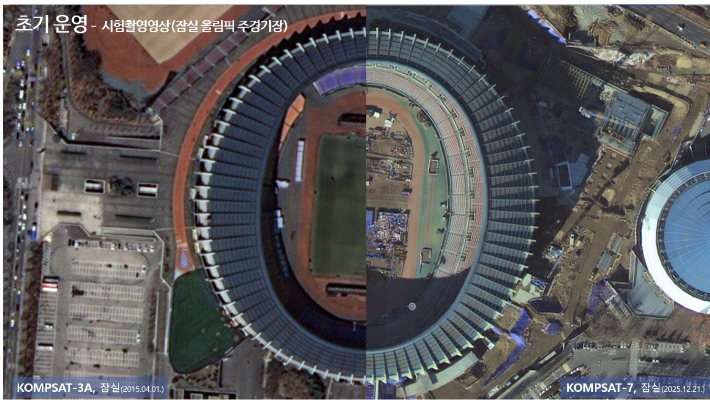
Test Images of Jamsil Olympic Stadium: KOMPSAT-3A (Left) vs. KOMPSAT-7 (Right)
Especially as disaster threats such as large-scale forest fires increase due to recent dry weather, KOMPSAT-7's precision observation capabilities are expected to play a vital role in monitoring disaster-stricken areas.
CAS500-3 is evaluated as a symbolic achievement marking the shift toward a "New Space" centered development system. Unlike previous public-led models, space specialized companies took the lead in overall satellite development, with the government and research institutes providing support.
The payloads integrated into CAS500-3 serve as a "comprehensive space laboratory" for space science exploration. This announcement included: High-resolution aurora observations by KASI’s ROKITS; Basic space environment data on space plasma and magnetic fields secured by KAIST’s IAMMAP; and Data obtained from space bio-experiments conducted by Hallym University’s Bio-Cabinet.
ROKITS observes Earth's aurora and airglow, while IAMMAP measures space plasma density fluctuations between day and night to secure data for space environment forecasting and research. Notably, ROKITS captured aurora images during a geomagnetic storm on February 14. Bio-Cabinet is currently conducting experiments to print 3D artificial heart tissue and cultivate stem cells derived from tonsils in a 3D environment.
These achievements are expected to become a powerful driving force, not only for an industrial leap through "private-led satellite mass production" but also for expanding a multi-faceted space science research ecosystem through industry-academia-research collaboration.
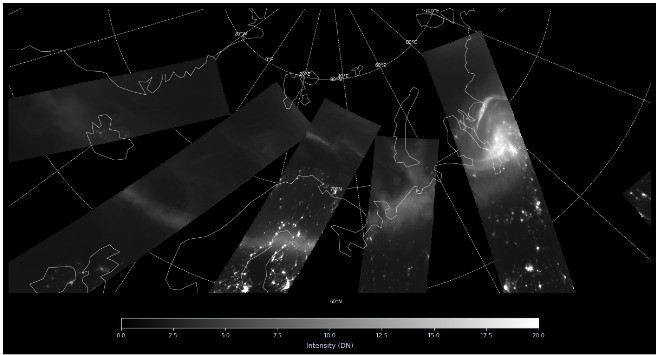
Aurora Ring Observed by CAS500-3 ROKITS: Captured during the geomagnetic storm on February 14, 2026. The bright area on the right indicates the aurora.
KASA is currently conducting initial operations, including Calibration and Validation to improve satellite data accuracy, and plans to transition both satellites to the full mission phase soon. Once routine operation begins, KOMPSAT-7 and CAS500-3 will stably provide high-quality imagery and observation data, fully assuming their roles as national space assets.
KASA Administrator Taeseog Oh stated, “The initial operational results of these two satellites are a feat that demonstrates a leap in South Korea's satellite development capabilities. They are tangible fruits announcing the strengthening of national Earth observation power and the opening of the private-led satellite development era. We will continue to drive space achievements that deliver tangible benefits to the public by organically linking satellite development, utilization, and industrial growth.”