SPHEREx Space Telescope Unveils the First All-Sky Map in 102 Infrared Colors
- All-Sky Map Captured in 102 Colors to Unlock Secrets of the Universe’s Evolution
-South Korean Scientists Join International Research Team to Analyze Cosmic Data
[ Related National Policy Tasks ]
Task 28. Development of NEXT-Generation Strategic Technologies to Lead the World
The Korea AeroSpace Administration (KASA, Administrator Yoon Youngbin) has announced the release of the first all-sky map captured by the SPHEREx* space telescope. Jointly developed by the Korea Astronomy and Space Science Institute (KASI), under the KASA’s umbrella, and NASA, this groundbreaking map was made public on December 19.
* SPHEREx: Spectro-Photometer for the History of the Universe, Epoch of Reionization, and Ices Explorer
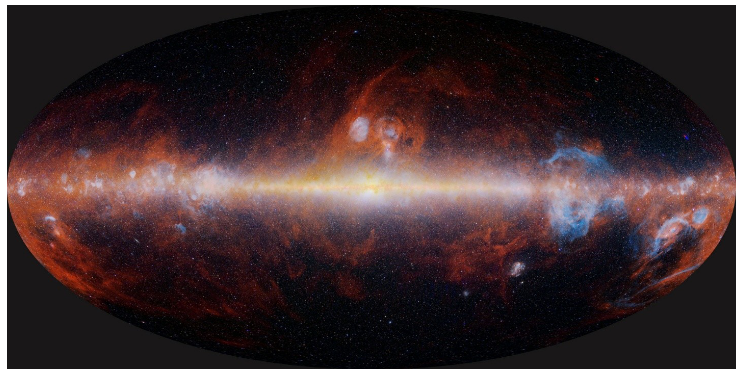
Figure 1. SPHEREx All-Sky Map Image (Credit: NASA/JPL-Caltech).
SPHEREx has mapped the entire sky in 102 infrared colors, revealing various cosmic features. This image shows a selection of those colors, representing infrared light emitted by stars (blue, green, and white), hot hydrogen gas (blue), and cosmic dust (red).
The newly released image is the first-ever all-sky map created by spectrally capturing the entire sky across 102 infrared wavelengths. Following its launch on March 12 this year, SPHEREx began full-scale observations on May 1 and completed the map after surveying the entire sky over approximately six months. As these infrared wavelengths are invisible to the human eye, Figure 1 was generated by translating these specific wavelengths into visible colors to represent different cosmic features. Stars are shown in blue, green, and white, while hot hydrogen gas appears in blue and cosmic dust in red.
Orbiting the Earth approximately 14.5 times per day, the telescope crosses the North and South Poles and passes through the polar regions. Every day, it captures around 3,600 images along a circular strip of the sky. As the Earth orbits the Sun, the telescope’s field of view shifts gradually. Over this period, the observations produce a complete 360-degree mosaic image of the entire sky. The research team then digitally combined these images to create the first all-sky map.
To carry out these observations, the telescope uses specially designed linear variable filters mounted on six detectors to observe 102 wavelength bands. Each wavelength provides unique information about galaxies, stars, star-forming regions, and other celestial objects. For example, dust clouds in our galaxy, where stars are densely forming, appear bright at certain wavelengths but are not visible at others. By leveraging these 102 colors, scientists can measure distances to hundreds of millions of galaxies and map their three-dimensional distribution.
The all-sky survey data will be utilized for key scientific missions, including exploring the history of the universe, the formation and evolution of galaxies, and the origin of water and ice related to the fundamental building blocks of life. The mission is led by NASA’s Jet Propulsion Laboratory (JPL), with data analysis conducted by 10 U.S. institutions, along with Korean scientists, including the research team led by Dr. Jeong Woong-seob of KASI. Korean researchers not only contribute to the core science missions and data processing, but also play a significant role in the scientific analysis of observational data across a wide range of research topics.
Over the two-year primary mission duration, the international research team plans to conduct three additional all-sky surveys. By integrating these datasets, the team aims to complete an integrated three-dimensional map with enhanced measurement sensitivity. Once processed, the entire dataset will be made available to both the scientific community and the general public free of charge. The data will be accessible worldwide through the NASA/IPAC Infrared Science Archive (IRSA), hosted by the Infrared Processing and Analysis Center (IPAC) at the California Institute of Technology (Caltech).
.
Acting Director of NASA’s Astrophysics Division, Shawn Domagal-Goldman, stated “I felt a thrill when I first encountered SPHEREx’s vast dataset. In just six months, this space telescope has produced 102 new maps of the universe. This remarkable dataset will serve as a treasure trove of discovery for astronomers around the world.”
Kang Kyungin, Director-General of the Space Science and Exploration Directorate at KASA, emphasized, “By utilizing observational data from the SPHEREx mission, our scientists will be able to play a pivotal role not only in our primary study on cosmic ice, but also in diverse fields such as active galactic nuclei and Small Solar System Bodies.”